Soil and Pit Tests

A few weeks back we made some progress on our structural engineering designs which I neglected to post about. As I covered in my previous post, our extension will require a foundation more substantial than the one under our current shack of an extension. When building an extension of our size the DOB requires a number of tests to inform how the extension is designed.

Test number 1 is called a Pit Test. This test is required because we need to know the depth of the foundation under our neighbor’s extension which is directly next to our planned extension. When 2 foundations are next to each other they must be the same depth otherwise one foundation puts unequal pressure on the other and one of them will eventually crack.
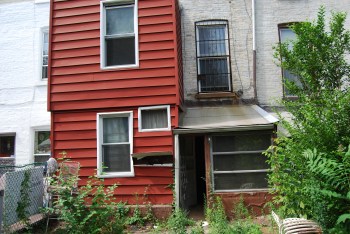
Lucky for us, the neighbor’s foundation is only a concrete slab on grade of about 1 foot thick. One foot isn’t deep enough to cause these pressure differences so we don’t have to be concerned with her foundation depth or do any underpinning. Underpinning is the task of digging the dirt out from under a foundation and filling in the gap with concrete.

Test number 2 is a known in New York City as a TR4 Soil Inspection. The purpose of this test is to learn the weight bearing properties of the soil under our future extension. I used to think of soil as a pretty solid substance but in truth it’s not. It’s really a fluid and the foundation of a building kinda floats in the soil. If the soil is significantly soft (like sand) we may need to drive deep pilings into the ground to support the load of our building. If the soil is hard enough we can simply do a shallow foundation also called footings. The shape of these footings will also depend on the soil quality.

To perform the soil inspection an engineering team sets up a boring machine which drills 20 feet into the ground and collects samples in hollow tubes which are then reviewed in a lab. It pretty much looks like those ice core samples you see sometimes on NOVA. Except of course it’s filled with earth.

A few weeks back we completed the boring test and the good news is that our backyard is mostly made up of clay, silt, and “sandy silt” which doesn’t require anything special for our foundation design.

In Case You Were Wondering… How to Calculate Your New York City Property Taxes

When we were first reviewing the finances for our house, we were struck by the low property taxes that the current owner was paying. We knew we wouldn’t get as good of a deal but didn’t know how to estimate them. Calculating New York City property taxes had always been a mystery to me. For the purposes of estimating our future expenses we simply rounded up to the nearest hundred and doubled her payment. Unfortunately, this strategy was flawed and our property taxes are more than we thought. On the bright side, with the help of our attorney, we learned a quick way to estimate them and it is much easier than we expected.

Basically, there are just 3 steps.

Step 1: Look up the assessed value of the property according the tax department records. You can easily look this up on the website www.propertyshark.com for free.

Step 2: If your income is less than $500,000 you qualify for the Basic STAR property tax exemption. To apply this exemption you subtract $1,670 from the assessed value found in Step 1. The amount of this exemption changes from year to year so verify the current STAR exemption rates with NY state’s website.

Step 3: Multiply the discounted assessed value by 18% and you have a good estimate of your tax bill. This rate applies to most residential properties such as homes and condominiums. The rate changes sometimes and you should verify it with the City’s website.

Here’s an example: Assuming the new home you’re looking at has an assessed value of $20,000 (assessed value has nothing to do with market value–so don’t freak out) and you qualify for Basic STAR. Your annual tax bill will be $3,299.40 that’s calculated by (20,000 – 1,670) x 0.18.

When you get your mortgage the bank should work with the title company to calculate your true tax bill for the next year (we learned the hard way). I believe they adjust the assessed value of the home in the process but it shouldn’t move by much and this formula should be accurate within a few hundred dollars.

There are a number of other exemptions you may qualify for if you are a senior citizen, veteran or disabled. If any of these apply I recommend researching this further on the NYC government website.

The Structural Engineer

Now that we’ve settled on the general layout of each floor it’s time to bring in the structural engineer. The structural engineer is necessary because of the extension we’re putting on the house. The engineer will review the architect’s designs and design a foundation and the structural components of walls capable of holding everything up over time without settlement or deflection.

North Elevation

Our plan is to add a 10 foot extension to the ground floor and a 6 foot extension to the parlor floor. The 4 remaining feet above the ground floor extension will serve as a deck for the parlor floor. The top floor will remain unchanged.

Currently, the rear wall of the building runs straight from the top floor to the rear basement foundation wall. This means that the weight of 3 floors of wall is held in place entirely by the rear foundation wall. Under our new design (shown in the North Elevation drawing above) each wall is staggered and thus we must place structural members under each wall capable of supporting the weight above it. We don’t have the designs yet, but mostly likely this will mean 2 large steel beams running the width of the building. One to hold up the existing top floor wall and one to hold up the parlor floor wall. The ground floor’s rear wall will be supported by the extensions foundation.

This past Saturday the engineer met us at the site with our architect to review the plans. We started by looking at the backyard and basement to begin designing the foundation. The engineer needs to design the foundation so that it can not only support our extension but so that it doesn’t cause any damage to our new neighbor’s foundations. If the foundation isn’t properly designed then over time there will be settlement, cracking and most likely an expensive repair project.

Luckily, one neighbor has no extension and the other only has a very small porch sitting on a concrete slab. We’ll need to underpin the porch’s foundation but according to our engineer this is pretty minimal effort compared to what would be required if either had a true extension.

We also need to determine what is under the concrete slab foundation of our home’s existing extension. It could be simply dirt, stones or more interestingly it could be some sort of landfill garbage. The engineer and architect told us several entertaining stories about digging up refrigerators and other sorts of debris on other jobs.

While they are both fairly confident that we’ll just find dirt, the DOB requires us to do a probe. This will involve contracting a team to bring out a large drill and digging a hole about 8 feet down to confirm the contents. Given that we haven’t closed and don’t own the home yet, we won’t be probing for a couple of weeks. I will post pics once this is done.

While we focused on the backyard and foundation design, the engineer also reviewed the rest of the building to confirm that we could move walls around as we desire. The good news is that because our brownstone is only 16 feet wide, we have no load bearing interior walls. Each floor is completely supported by the floor joists which run between the party walls. On wider brownstones this was not common because the larger the run the larger the floor joists. If the home is 20 or 25 feet wide the floor joist would need to be impractically large. On these wider buildings often the wall separating the stairs from the rooms is load bearing.

Although I’m a software engineer by trade, I did take some civil engineering classes in classes and understand the basics of these structural engineering concepts. Aside from designing the room layouts this has been my favorite part of the process.