Tiling bathrooms – what to know before your contractor tiles

Throughout our renovation we have done most of our research and shopping online,  however, tiles are the one thing where a bricks and mortar store is where you want to go.

When initially planning out our bathrooms we considered what tiles to use.  We still had a box of tiles left from our former condo renovation.  We were happy with those tiles so why not use them again?  Nothing is ever that easy.  We tried to contact the previous tile store we used but, alas, they were out of business.  We looked online and did find the tiles but could not find any in stock. In fact many online tile retailers represented tiles on their website that they did not actually have in stock.

Tiles in our old bathroom - they were Italian and discontinued

Tiles in our old bathroom – we loved them.  They were Italian and discontinued.

We did some research and found a few tiles places that we checked out.  Classic Tile, located in Brooklyn and Staten Island (the SI store is open on Sundays) has a large showroom and a good selection.  Unfortunately, all the tiles we chose there were discontinued, which we were not able to find out until Monday when the store could call the distributor.  We also could not find them in stock online anywhere else.  Next, we went to Mondial Tiles, a family-run business located in Bensonhurst, Brooklyn.  They have a good selection of tiles and are also counter top fabricators.  The owner, Alex De Meo, was very helpful with putting together a selection of tiles that worked.

How To Plan Out Tiles

The number one rule in renovation:  don’t assume the contractor knows what you want or will make the same choices. You want to be as specific as you possibly can.

When our contractor was ready to tile, we knew we had to make it clear what tiles we wanted where.  Although we did not choose an overly complicated tiling design it still needed some explaining so we drafted a rudimentary illustration.  We also numbered all of the materials on the drawings as well as with tape so they would know, for example, what grout needed to be used with what tiles.  We were totally prepared, right?  Wrong.

When our contractor installed the cement board around our bath, an unplanned alcove was created beside the tub.  We liked the utilization of this previously wasted space but it had not been factored into our tile order.
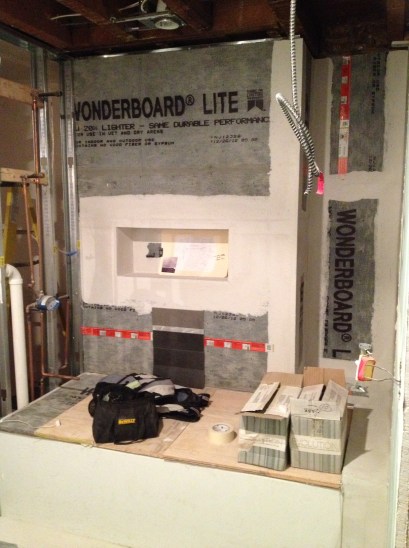
alcove on the right

alcove on the right

Picking out tiles and the correct square footage is not enough,  you need to make sure you plan exactly how many tiles you will need both vertically and horizontally along each wall accounting for grout lines as well.  Rarely will the tiles line up exactly with the wall dimensions so they will need to be cut somewhere.  These plans should also account for plumbing fixtures, shelving and any other details that you want your tiles to line up with.

What you need to decide is where you want the cut tiles placed.  If you don’t the tile guy is going to make that decision and you may not be happy with the results.  Sadly, we learned this the hard way and on one wall we had about one inch of space left over and did not like the way the tiler solved the issue.  A further disappointment was that the grout line was slightly crooked.  We haven’t figured out how to fix it other than getting them to straighten the line.

Tile line

There is one other spot where the grout lines do not match up (see below), can you find it?
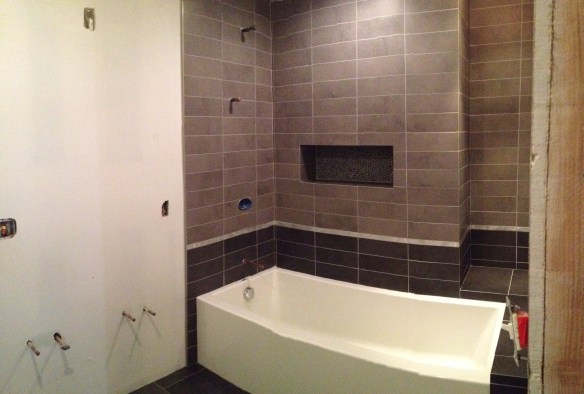
master bath tile

Overall, we are pleased with our master bath tile choices–once we have figured out what to do with the angry inch.  For now, we (me) will just have to dream about baths in the new longer tub with the built-in shelf where all the shampoo bottles will not be falling off the side of the tub.

 

Heating, Ventilation and Air Conditioning Systems

When our brownstone was built 100 years ago there was, of course, no such thing as cooling systems so when deciding what HVAC system to install, we had to make some compromises.

Our three options were:  central air conditioning, a ductless split-AC system and window or sleeve mounted units.

Window or sleeve mounted units:  No.  We have lived in many apartments that had window mounted AC’s and they were always loud and they blocked light and well they are just plain ugly.  Our condo had the units that fit into a wall sleeve but they were unsightly on the outside of the building and there is little selection depending on what size sleeve you had.  We bought one new and it was very loud and was still fairly large as it protruded from the wall of our already small bedroom.

Central Air:  The plus to this option is obviously that there are no visible units as they are built into a duct system.  With this option, if you are remodeling an old house you must consider that it was not designed to have duct systems.  These might interfere with ceiling and wall moldings or other period details.  In our opinion, this is the best option if you are gutting your home because they can custom design the ducts in the least intrusive way.  The other downside to this system is that it can be the most expensive.

Split AC Systems:  This is the one we chose.  Since ours was not a gut renovation, we were concerned about creating a system of ducts.  The plus side to these systems is that they are very quiet and cool each room separately. With central air, most systems are designed so that you set the temperature by zone or even for the entire house.  That means you are cooling more of your house than you need to and that is costly.  With a split AC, if you want to cool say only the bedrooms at night you can, which makes this cheaper to operate.  It also has a heat function so that if you a blast of heat in one room you can.  This might come in handy since the front of the house gets sun all day while the back of the house does not.  The down side is that even with the unit attached high on the wall, the in-room units are still pretty big, bulky and I’ll admit it, ugly.

First, you need to install the compressor. We considered putting it in the backyard but did not want to deal with a loud hot compressor next to our patio. We ended up putting it on the roof so it would be completely out of the way.

When installing the compressor on the roof you have a few options. The DOB does not allow it to be mounted directly to the roof. Instead you must put steel bars across your roof parapets or mount it directly to your roof parapet on a rack. The parapet mount is much more economical assuming your parapet is high enough. If not, you can extend it a few feet with some CMU blocks as we did. This is still more economical than the steel bars.

compressor

We chose a 4 zone single compressor Mitsubishi system and hired a separate plumbing company to install it (our contractor did not have a particular expertise in this area – don’t ask).

front ac

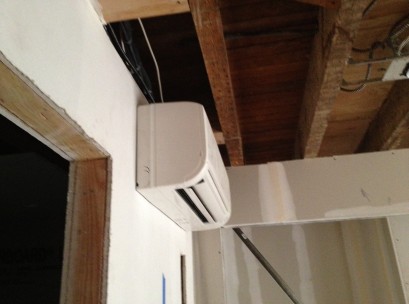
Next, each wall unit is installed. Even though you are not creating ducts you still need to open walls and install some plumbing. There are coolant feed and return lines that run from the compressor to each unit as well as a power cord and a condensation drain. The condensation drain runs from the wall unit down to your building’s waste line.

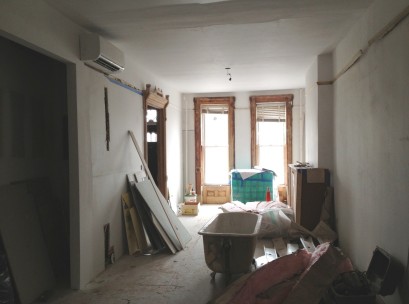
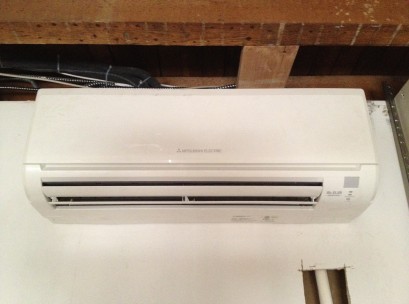
All the units were installed this week, which is great because now walls can be closed and finished.  Next to the extension, this was the next big hurdle to jump.  Here are a few photos of them installed.  We tried to put them in the least intrusive spots.  We are not very happy with the parlor floor unit.  It sticks out like a sore thumb.  There really were no other options so we will have to live with it.  The other units were placed so that they could not be seen when you first enter the room.

Parlor floor - sticks out like a sore thumb but not much we could do.

Parlor floor – sticks out like a sore thumb but not much we could do.

Master bedroom - not as obvious tucked in the corner

Master bedroom – not as obvious tucked in the corner

Just don't look at it from the side!  Maybe me can hang a plant off it or something.

Just don’t look at it from the side! Maybe me can grow some ivy around it or something.

7 Steps for a Successful Sale by Owner

fsboNo, we are not giving up and selling our house.

After putting an offer on our current money pit we started the process of selling our condo so that we could afford to renovate our new home.  We decided to sell it ourselves and were so glad that we did because we needed every cent we could get.

We thought others out there would benefit from our experience.

  1. The first thing you need to do is get your home in shape to show to prospective buyers.  My advice is to watch a bunch of episodes of HGTV’s Designed to Sell.  The show covers how to upgrade the look of your home on a budget.  A little paint and a lot of organization will go a long way.  When you take photos of your home make sure you removed clutter.  All those nik-naks you love will just make your home look smaller, so box them up and store them in the closet or better in a storage facility.  When we had an open house we would put stuff in our car.  There are apps that allow you to take panoramic photos of a whole room so they look spacious.
  2. Create a blog on WordPress or some other free blogging service.  You can present all the information that potential buyers need in a clean efficient manner.  Things like taxes, utilities, maintenance fees and you can even feature highlights of your neighborhood.
  3. List your home in MLS.  All the real estate websites feed off of MLS.  You need to do this through a realtor service.  We used Clickit Realty and it cost about $500 for 6 months.
  4. Clear out during the open house.  If you have kids or dogs, get them out of the house while one person hosts the open house.  The last thing you need is your pet growling at prospective buyers or worse your child telling them she saw a cockroach the other day.  We once went to an open house where the owner was in the front room laying on the sofa apparently sick.  UNCOMFORTABLE.
  5. Curb appeal.  Even if you live in a condo make sure the hallway or entryway is clean and smells good.  Pick up any trash in the front of the building.
  6. Clean your home.  Really clean your home.  I’m talking q-tip detailed car clean. You should give your home a complete once over before your first open house and then as needed.
  7. Price your home accurately.  Check out real estate in your area and make sure your property is not listed too high or too low.