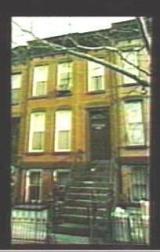
Our House Through the Century

We recently had the opportunity to meet a couple of our new neighbors and chat about the neighborhood. One gentleman, who has lived in his house forever, could not understand why we “young” people wanted to live in an old house.

Old houses have always appealed to me. They are living history and if they are old enough, you can imagine the ghosts of the previous inhabitants wandering within the walls. We decided to find out as much about the history of our house as we could.

First stop: Municipal Archives

We learned from a friend’s renovation blog, Gowanhaus, that during the 1940s, NYC began to use photography as a tool for appraising real property for taxation purposes. Over 720,000 35mm black-and-white pictures were taken of every building in the five boroughs. According to the government website, by the time the Municipal Archives accessioned the collection, the original nitrate negatives had begun to deteriorate and exhibit signs of “redox” blemishes (which look like giant snowflakes). With grant funds from federal, state, and private sources, the Archives duplicated the original negatives so that new prints could be produced and copied to microfilm so that patrons can easily and safely view the entire collection. The end result is that you can now order a print of your building taken in the 1940’s or the 1980’s at a cost of $35 to $60 per print.

We ordered our photo online and opted to pick it up at the records office ourselves. This turned out to be a great choice because the Surrogate Court building, where the municipal archives are located, is something to see. The building, located at 31 Chambers Street, was originally designed for use as a Hall of Records and this was its original name. The Surrogate’s Court was one of the original tenants, with courtrooms, offices and chambers on the 5th floor. The building was renamed the Surrogate’s Courthouse in 1962.

According to the government website, the building was constructed between the years 1899-1907 in the Beax-Arts style. It has a beautiful grand marble staircase and carved wood paneling. The building must be quite an expense to keep up as evidenced by the fact that all the doors have these beautifully detailed door knobs but most have one handle missing. I guess Victorian brass door knobs are not that easy to come by.

The tax photo from the 40’s (below left) shows the house looking very much the same as it does today.  The brick facade and the window style looks the same but the double door was replaced sometime before the 80’s (below middle) to the single wooden door it has today (below right).  When funds permit, we’d like to go back to the double door style.  The frieze looks exactly the same and is still in great condition.

40's

Be Green

One of the challenges of renovating an old house is deciding what to keep and what to toss. Some features can’t be restored and others you just don’t want to. For instance, this built-in cabinet looks like it is original to the house. It has a marble top and Victorian-looking drawer pulls.

Drew hates it. I have mixed feelings. I love the detail but in reality we need a closet in that location and it is not very elegant. It’s the same for other details in the house such as some of the moldings and a cast iron claw-foot tub. But we can’t just throw them out because they are history! Enter Build it Green, NYC.

Build It Green! NYC,  located in Brooklyn, is a non-profit retail outlet for salvaged and surplus building materials and home furnishings. The warehouse has everything from panel doors to high end refrigerators. On our last visit, they even had an antique phone booth. Our daughter could not figure out how the dial telephone worked. Its mission is to keep materials out of the landfill, while offering deep discounts on their resale. What we can’t sell, we will donate here and get the tax deduction. Oh yeah and be green.

Another good resource that we plan on checking out is Demolition Depot, located in Harlem. This shop is a popular source for vintage plumbing fixtures, doors, windows, shutters, railings, gates, grills, mantels, stone and terracotta pieces, religious objects and more. Its fixtures are geared towards the re-creation and renovation of period places.

The Structural Engineer

Now that we’ve settled on the general layout of each floor it’s time to bring in the structural engineer. The structural engineer is necessary because of the extension we’re putting on the house. The engineer will review the architect’s designs and design a foundation and the structural components of walls capable of holding everything up over time without settlement or deflection.

North Elevation

Our plan is to add a 10 foot extension to the ground floor and a 6 foot extension to the parlor floor. The 4 remaining feet above the ground floor extension will serve as a deck for the parlor floor. The top floor will remain unchanged.

Currently, the rear wall of the building runs straight from the top floor to the rear basement foundation wall. This means that the weight of 3 floors of wall is held in place entirely by the rear foundation wall. Under our new design (shown in the North Elevation drawing above) each wall is staggered and thus we must place structural members under each wall capable of supporting the weight above it. We don’t have the designs yet, but mostly likely this will mean 2 large steel beams running the width of the building. One to hold up the existing top floor wall and one to hold up the parlor floor wall. The ground floor’s rear wall will be supported by the extensions foundation.

This past Saturday the engineer met us at the site with our architect to review the plans. We started by looking at the backyard and basement to begin designing the foundation. The engineer needs to design the foundation so that it can not only support our extension but so that it doesn’t cause any damage to our new neighbor’s foundations. If the foundation isn’t properly designed then over time there will be settlement, cracking and most likely an expensive repair project.

Luckily, one neighbor has no extension and the other only has a very small porch sitting on a concrete slab. We’ll need to underpin the porch’s foundation but according to our engineer this is pretty minimal effort compared to what would be required if either had a true extension.

We also need to determine what is under the concrete slab foundation of our home’s existing extension. It could be simply dirt, stones or more interestingly it could be some sort of landfill garbage. The engineer and architect told us several entertaining stories about digging up refrigerators and other sorts of debris on other jobs.

While they are both fairly confident that we’ll just find dirt, the DOB requires us to do a probe. This will involve contracting a team to bring out a large drill and digging a hole about 8 feet down to confirm the contents. Given that we haven’t closed and don’t own the home yet, we won’t be probing for a couple of weeks. I will post pics once this is done.

While we focused on the backyard and foundation design, the engineer also reviewed the rest of the building to confirm that we could move walls around as we desire. The good news is that because our brownstone is only 16 feet wide, we have no load bearing interior walls. Each floor is completely supported by the floor joists which run between the party walls. On wider brownstones this was not common because the larger the run the larger the floor joists. If the home is 20 or 25 feet wide the floor joist would need to be impractically large. On these wider buildings often the wall separating the stairs from the rooms is load bearing.

Although I’m a software engineer by trade, I did take some civil engineering classes in classes and understand the basics of these structural engineering concepts. Aside from designing the room layouts this has been my favorite part of the process.