Lead Out! How to Safely Remove Lead Paint

Most of our renovations will be done by professionals because a) we have full-time jobs, and b) we don’t have the skills or know-how to do much of the work.

While it would be nice to hire people to do all of the work, we want to try to reduce some of our costs by completing some tasks ourselves, like some of the demolition work.  One of the projects we have decided to tackle is stripping some of the old doors.  There are two sets of double doors:  one set leads into our daughter’s room and the other into what will be our living room.  They look like they are original to the house and therefore over 100 years old.  They have nicks and dents and show some signs of decay and years of minor repairs. We are not sure whether they are worth stripping and re-painting but we are going to give it a try and see what happens.

Since the doors have obvious signs that there are multiple layers of paint, we suspect that the early layers may be lead paint so we researched paint removal products specifically for lead paint and found Franmar’s Lead Out.

Lead Out renders lead paint non-hazardous for safe removal and inexpensive disposal.  According to the company’s website a special patented Molecular Bonding System is used where the product reacts with lead at the molecular level to alter the lead compounds to a non-hazardous compound making it easy to remove and safe to dispose of. The product is made from American grown soybeans and is biodegradable.

Step By Step:  How to Strip Lead Paint From Door with Lead Out

Purchase Lead Out™ Paint Stripper, Quart

Step 1:  Gather the supplies you will need.

Lead Out comes with the gel, activating powder, plastic gloves, mask and a stir stick.  We started with a gallon container and a package of powder that says it should be enough to cover 250sqft.  If you are only planning on stripping a small area at a time like we were, then you need a small plastic container and a measuring cup to mix a smaller amount.   You will also need a paint brush to spread it around and scrapers to remove it.  I recommend plastic scrapers for wood as the metal ones dig into the softened wood.   I also recommend a number of rags and a bucket of water and extra gloves.

Step 2:  Mix appropriate quantities.

You must wear the mask for this stage.  To mix a smaller amount, you want to mix equal percentages of each container. We mixed ¼ of the gel and ¼ of the powder together until it formed a thick paste.  This was more than enough to cover two doors and then some.  I’d recommend starting with less, probably a 1/16th of each would have been perfect for the 6′ x 2.5′ door we stripped. Also, you must use all of the product in one shot as it can’t be saved for another day.

Step 3:  Preparing the work area.

We were working in an empty house so for us it was easy.  We just put down a plastic sheet and then we used two workbenches to support the door so we could lay the door flat stand while we applied the paste.  Since there were several coats of paint on the door handle, we did not remove its hardware before applying the product.

Step 4:  Applying the product.

We applied the paste with a paintbrush.  The directions say to apply it liberally in one direction, as opposed to painting where you go over it back and forth.  In retrospect, I wish we had poured it on like they do in the video and then used the brush to spread it around.

Step 5:  Waiting

The directions say to wait several hours (at least 5) before removing it with a scraper.   See photo on the left, this was only after an hour.

We waited overnight before removing it and either that was a little too long and it dried out or we did not apply it thickly enough because in some areas it was a little dry and harder to get off.

Step 6:  Scraping

Lead Out removed several coats of paint.  There were at least three colors and you figure they may have repainted those a few times.  We definitely were able to see right down to the wood after the first scrape.  There were still some areas where it was difficult to get the paint out like crevices and grooves in the wood design.  We might try an old toothbrush next time.  We will also try another light coat of the product and let it sit for only a few hours to get the last remaining bits.  This is where the rags and the water come in.  When you scrape off the paint it is very sticky and thick and adheres to the scraper.  It helps to have a wet rag to wipe it off after every few scrapes and we’d recommend rubber gloves for that reason as well.

All in all we were happy with this product for stripping wood and we will be trying it on some other surfaces as well.  The next step will involve sanding the door once it is dried.  Stay tuned for that.

Warning:  the following video is our first attempt and is, to say the least, amateur.   Hey, we’re not actors.  It is shot with aniPhonee and edited with the mobile app, ReelDirector.

Franmar generously provided us with a complimentary gallon sample of the Lead Out to get our project started.

Work Update

Well, we are still waiting for the Letter of No Objection.  It seems that the seller’s attorney received a notice saying it was approved by the examiner but not by the assistant commissioner at the DOB—whatever that means.  We are not sure what steps they are taking to appeal that decision.  Meanwhile, we are waiting with our completed paperwork to file an Alteration 2 application.  If indeed we do not get it it could set our renovation back a few months, which would be financially and emotionally painful.

apt floor plan

But onward and upward, we are going forward with updating the rental unit because there is work that does not require permits such as stripping and sanding the floors, repairing cracked walls, updating the electrical (which has its own separate permits) and replacing and/or repairing very damaged ceilings.

The Ceilings

After tearing out the drop ceilings, we hired a contractor that we have worked with before on the renovation of the bathroom in our current apartment.  We need him to  remove the damaged plaster ceilings in the dining area, living room and a small room of the bedroom so that we can proceed with the electrical work.  Then we will remove all the baseboard moldings to facilitate the wires for the electrical outlets and the cable wires.  Once the electrical work is complete we will go back and repair the walls and install new baseboard moldings.

small room before

The bedroom ceiling is in pretty good shape and it has nice moldings so we are going to try to repair rather than replace it.

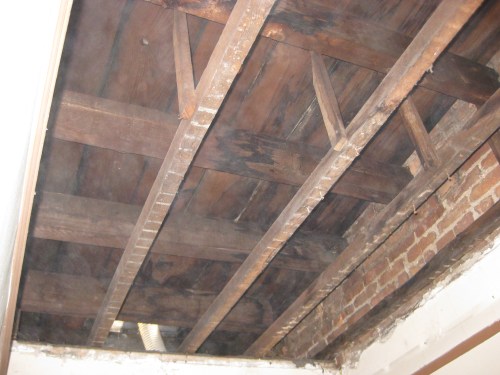
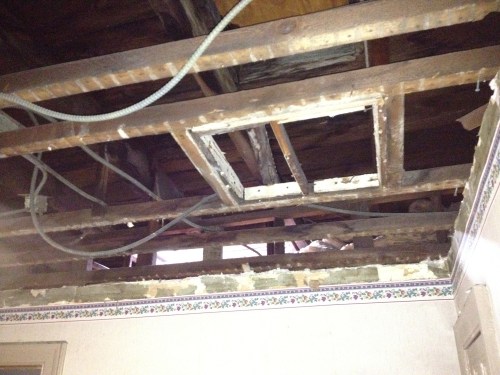
The ceiling removal took less than a weekend to do.  With all the ceilings removed we can can now see what shape  the roof is in.  Except for some old water stains on the beams, everything looks pretty good but we will want our structural engineer to have a look just the same.  These ceilings may never be opened again so if any of the beams need reinforcement, now is the time to do it.

small room after

small room after

One  exciting find under our ceilings was the amount of clearance between the old ceilings and roof joists. In the small room there is nearly 2 feet of additional clearance which would allow us to raise that ceiling to 10 feet. In the living room and dining area we can raise the ceiling about 8 inches. Once we have an estimate from our contractor we’ll do a cost benefit analysis to decide if it’s worth the extra expense – after all this is the rental unit.

dining area before

dining area after

dining area after

living room after

Fifty Shades of Grey (Linoleum)

While waiting for the decision to the Letter of No Objection, we decided to get to work on the rental apartment since we are not doing any work on it that requires us to wait for building permits.  Also, we may need to cram into this one bedroom unit for a while because we will most likely sell our current apartment before the renovations have completed.

I have to admit when we first looked at the house, I saw this apartment as requiring only minimal work:  tearing out the linoleum and refinishing floors along with some paint and plaster work.  At second glance—the place is a dump.  Not really, but it is really showing its age in some places and you can tell a little old lady resided there once (flowered wallpaper and gingham curtains).

Our visions of removing the linoleum to find a pristine hardwood floor that had been protected over the years by the layers of vinyl were quickly dashed.  We started with the bedroom first.  Layers one and two came off pretty easily, the third lay  er (a wood imitation pattern) was a little more difficult because it had some sort of paper layer glued to it.  Eventually it all came off.  My favorite layer was the imitation shag carpet pattern with yellow and red squares.

Next, we tackled the dining area.  In here there were not three, but five layers of linoleum!  After the first layer, which we were able to cut and roll up, the subsequent layers were much trickier.

Eventually we got to the bottom layer only to discover that the person who installed it decided to make sure it would never come up putting a nail every six inches.  These were a lot of fun to get out.  The only interesting part in the process were the baseball cards we found from the 50’s between layer one and two.  Sadly, they were not well preserved—we could have used a Mickey Mantle in perfect condition to fund some marble counter tops.  The floors underneath are basically pine sub-flooring (no intricate woodwork here).  It looks like they were painted over as some point so they will need to be stripped (?) sanded and stained.  There are some areas where it looks like there was some water damage.  We will need to remove all the baseboards to complete this work.  They are not in great shape so we don’t mind but we will install new ones in the exact same style if we can.

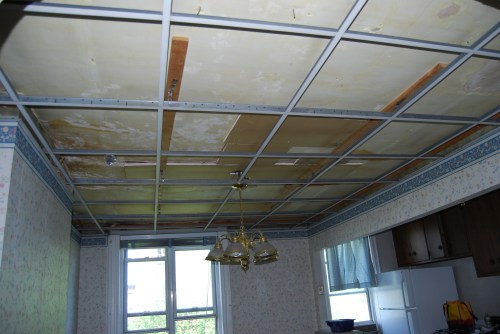
Next on the agenda was dealing with the drop ceilings.  We have friends who removed a drop ceiling to reveal twelve foot ceilings with original molding.  We, however, had no illusions going in because a few of the acoustical panels had stains on them so we were pretty sure that the drop ceilings were added, not to reduce heating bills as was often done, but to cover up peeling plaster and water damage.   And… we were correct.  

The small room off the bedroom and the dining area both had acoustical paneling that was easy to remove.  As we suspected, lots of water stains and what looks like wood panels that were probably put up to stop the falling plaster due to past water damage. We know that no leaks are present because we have been to the house after heavy rains and saw no water leaking or wet spots.  It looks like we will have to remove these ceiling completely and put in dry wall.  The bedroom ceiling is in good shape except for some peeling paint.  The molding in there is nice so we will save that ceiling by skim coating the surface.